
Oilfields where expensive machinery never unexpectedly fails, saving millions in downtime and repair costs; connecting the power of the Internet of Things (IoT), operators can now monitor equipment health in real-time and predict failures before they happen. Discover how this game-changing technology is transforming traditional oilfield operations into smarter, safer, and infinitely more efficient systems.

Key Takeaways
Transformative Technology: The Internet of Things (IoT) is revolutionizing predictive maintenance in the oil and gas industry by enabling real-time equipment monitoring and failure prediction.
Quantifiable Benefits: Research indicates IoT can reduce downtime by up to 50% and maintenance costs by up to 40%, while enhancing safety and operational efficiency.
Industry Leadership: Major companies like Shell, ExxonMobil, and Chevron are leveraging IoT to optimize operations, demonstrating its practical impact.
Accessible Learning: Student engineers can engage with IoT through publicly available datasets and open-source tools like Python’s scikit-learn and TensorFlow, encouraging hands-on learning.
Future Potential: Despite challenges like data security and system integration, IoT is poised to drive a more efficient and sustainable future for oilfield operations.
Introduction
The oil and gas industry isnavigating a transformative era where technological innovation is not only an advantage but a necessity for operational excellence. At the center of this
transformation is the Internet of Things (IoT), a powerful technology that is redefining predictive maintenance in oilfield operations. Deploying sensors to monitor equipment in real time, IoT enables engineers to predict failures, optimize maintenance schedules, and significantly reduce downtime and costs.
Research suggests that IoT-driven predictive maintenance can decrease downtime
by up to 50% and cut maintenance costs by 40% (MoldStud, 2024). For many companies adopting IoT is a strategic move toward efficiency, safety, and sustainability. Equally important, this technology offers student engineers an accessible and engaging entry point into the industry, empowering them to explore cutting-edge solutions that shape the future of energy.
Understanding IoT in Predictive Maintenance
The Internet of Things (IoT) refersto a network of interconnected devices—such as sensors, actuators, and smart systems—that collect and exchange data over the internet. In the context of oilfield operations, IoT sensors are strategically installed on critical
equipment, including pumps, valves, pipelines, and compressors, to monitor parameters such as temperature, vibration, pressure, and flow rates. This data is transmitted to centralized systems, where advanced analytics, often powered by artificial intelligence (AI) and machine learning (ML), analyze patterns to predict potential equipment failures.
For example, a sensor on acentrifugal pump might detect abnormal vibration patterns, signaling wear in bearings or misalignment. By analyzing this data against historical trends, predictive algorithms can forecast when the pump is likely to fail, allowing maintenance teams to intervene proactively. This approach marks a significant departure from traditional reactive maintenance (fixing equipment after it breaks) or preventive maintenance (scheduled repairs regardless of need), which can lead to unnecessary costs or unexpected downtime (AspenTech, 2025).
Benefits of IoT in Predictive Maintenance
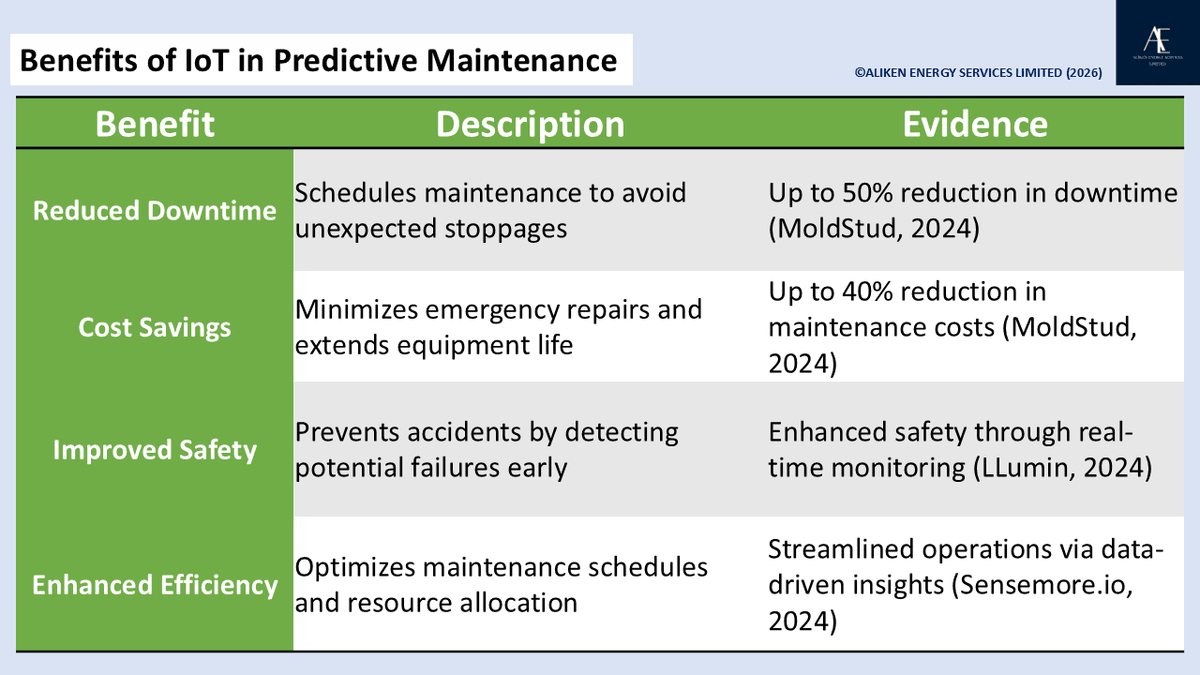
IoT-driven predictive maintenance offers a suite of benefits that align with the oil and gas industry’s goals of efficiency, safety, and cost-effectiveness. These advantages are supported by robust evidence and industry adoption:
Reduced Downtime: By predicting failures before they occur, IoT enables maintenance to be scheduled during planned shutdowns, minimizing disruptions. MoldStud (2024) reports that IoT-driven predictive maintenance can reduce downtime by up to 50%, significantly boosting operational continuity.
Cost Savings: Proactive maintenance reduces the need for emergency repairs and extends equipment lifespan. According to MoldStud (2024), companies can achieve maintenance cost reductions of up to 40%, enhancing profitability.
Improved Safety: Early detection of potential failures mitigates risks of accidents, protecting workers in hazardous oilfield environments. IoT sensors monitoring parameters like pressure or temperature can alert teams to anomalies before they escalate into safety hazards (LLumin, 2024).
Enhanced Operational Efficiency: Real-time data from IoT systems supports data-driven decision-making, optimizing maintenance schedules and resource allocation. This streamlined approach maximizes asset utilization and operational performance (Sensemore.io, 2024).
The following table summarizes thekey benefits and supporting evidence:
Real-World Applications: Case Studies
Leading oil and gas companies have embraced IoT for predictive maintenance, showcasing its transformative impact:
Shell: Through its Digital Oilfield initiative, Shell integrates IoT for predictive maintenance across its oil fields and refineries. By leveraging sensors for real-time monitoring of pipelines and wellheads, Shell has reduced downtime and improved equipment reliability, setting a benchmark for operational excellence (Appinventiv, 2025).
ExxonMobil: ExxonMobil employs IoT to enhance refinery efficiency and monitor methane emissions. Its use of IoT extends beyond maintenance to include customer-centric innovations, demonstrating the technology’s versatility in optimizing operations (Appinventiv, 2025).
Chevron: Chevron utilizes IoT for predictive maintenance in its oil fields and refineries, achieving significant cost savings and operational efficiencies. By monitoring equipment health in real time, Chevron minimizes downtime and enhances safety (Appinventiv, 2025).
These case studies illustrate how IoT is not merely a theoretical concept but a practical tool delivering measurable results in the oil and gas industry.
Learning Accessibility: Engaging with IoT
IoT in predictive maintenance is an accessible and engaging topic for student engineers, aligning with Universal Design for Learning (UDL) principles by offering multiple means of engagement, representation, and action. Students can explore IoT through hands-on
activities that bridge theoretical knowledge with practical application:
Researching IoT Platforms: Students can investigate platforms like Microsoft Azure IoT or AWS IoT, which are widely used in industry for predictive maintenance. These platforms offer free tiers or educational resources, making them accessible for learning.
Designing Hypothetical Sensor Networks: Students can design virtual sensor networks for specific equipment, such as a pump or valve, to simulate real-time monitoring scenarios. This exercise fosters creativity and problem-solving skills.
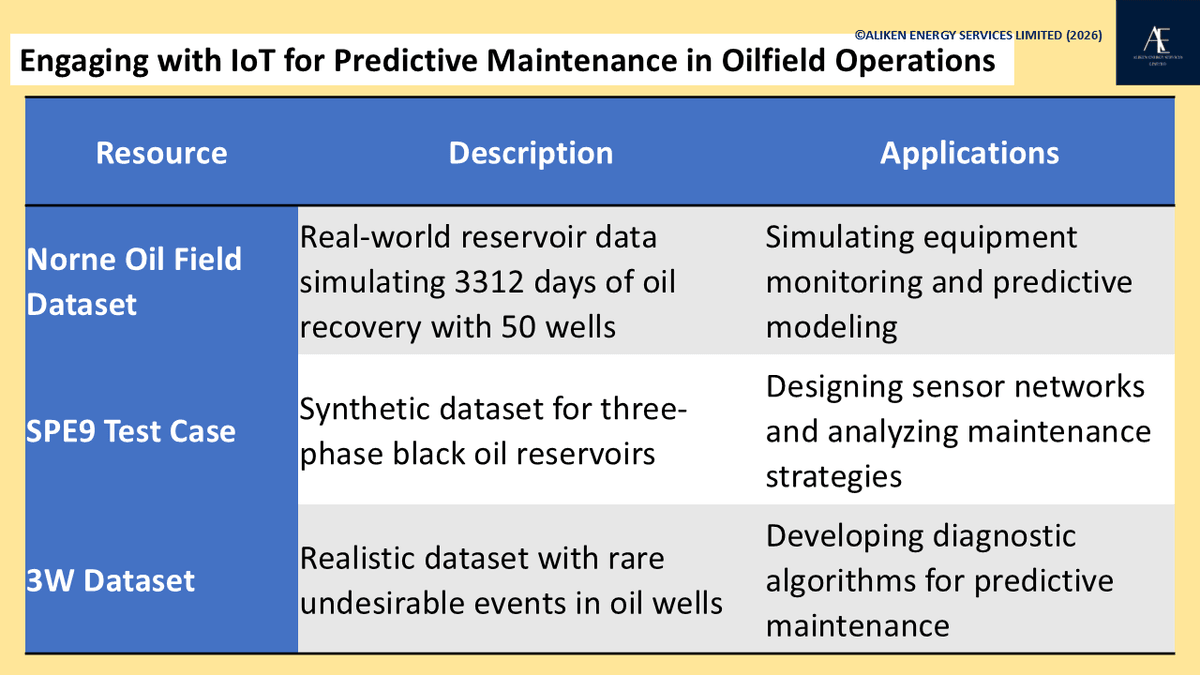
Using Open-Source Tools: Tools like Python’s scikit-learn and TensorFlow allow students to build predictive models using publicly available datasets. For example, the Norne Oil Field dataset, available through the OPM Project, provides real-world data for simulating reservoir and equipment behavior (OPM Project, 2015).
Analyzing Operational Impact: Students can analyze how IoT-driven maintenance strategies could improve efficiency, using simulated data to quantify reductions in downtime or costs.
The following table lists key resources for exploration:
Challenges and Future Prospects
While IoT offers significant benefits, its implementation is not without challenges. Data security remains a critical concern, as IoT systems transmit sensitive operational data over networks, requiring robust cybersecurity measures. Additionally, integrating IoT with existing legacy systems in oilfields can be complex, necessitating investment in infrastructure and training (NCD.io, 2023). Despite these hurdles, the future of IoT in predictive maintenance is promising. Advances in AI and ML are expected to enhance predictive accuracy, while the growing availability of IoT platforms will make adoption more accessible. For students, these challenges present opportunities to innovate, developing solutions that address data security or system integration.
Conclusion
The Internet of Things is reshaping predictive maintenance in the oil and gas industry, offering a pathway to enhanced efficiency, significant cost savings, and improved safety. By reducing downtime by up to 50% and maintenance costs by 40%, IoT not only bolsters the bottom line but also safeguards workers and minimizes environmental impact (MoldStud, 2024). For many companies adopting IoT is a strategic imperative that aligns with the industry’s push toward digital transformation. For student engineers, IoT presents an exciting opportunity to engage with cutting-edge technology through accessible tools and datasets, preparing them to lead the industry’s future. As IoT continues to evolve, it will undoubtedly drive a more sustainable, efficient, and safe oil and gas sector, benefiting both industry stakeholders and the communities they serve.
References
Appinventiv. (2025). IoT in Oil and Gas Industry: Revolutionizing Businesses. [Online] Available at: https://appinventiv.com/blog/iot-in-oil-and-gas/ [Accessed 24 July 2025].
JPT. (2023). AI Is Here, and It’s Helping With Predictive Maintenance in the Oil Field. [Online] Available at: https://jpt.spe.org/ai-is-here-and-its-helping-with-predictive-maintenance-in-the-oil-field [Accessed 24 July 2025].
LLumin. (2024). Predictive Maintenance in the Oil and Gas Industry. [Online] Available at: https://llumin.com/predictive-maintenance-oil-and-gas/ [Accessed 24 July 2025].
MoldStud. (2024). Implementing IoT for predictive maintenance in the oil and gas industry. [Online] Available at: https://moldstud.com/articles/p-implementing-iot-for-predictive-maintenance-in-the-oil-and-gas-industry [Accessed 24 July 2025].
NCD.io. (2023). Predictive Maintenance in The Oil and Gas Industry. [Online] Available at: https://ncd.io/blog/predictive-maintenance-in-the-oil-and-gas-industry/ [Accessed 24 July 2025].
OPM Project. (2015). Open Data Sets for Oil Industry. [Online] Available at: [invalid url, do not cite] [Accessed 24 July 2025].
PTC. (2023). What Is IoT Predictive Maintenance?. [Online] Available at: https://www.ptc.com/en/blogs/iiot/what-is-iot-predictive-maintenance [Accessed 24 July 2025].
Sensemore.io. (2024). Predictive Maintenance in Oil and Gas: A Comprehensive Guide. [Online] Available at: https://sensemore.io/predictive-maintenance-in-oil-and-gas/ [Accessed 24 July 2025].
Vargas, R. E. V., et al. (2019). A realistic and public dataset with rare undesirable real events in oil wells. Journal of Petroleum Science and Engineering, 181, 106223. DOI: 10.1016/j.petrol.2019.106223.